Types of Dives and Diving Positions in Sport Diving
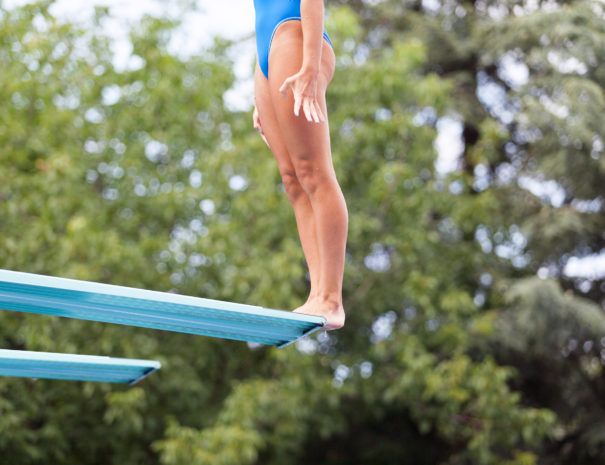
Did you watch any of the diving during the last summer Olympics? The level of precision these athletes exhibit is pretty impressive, isn’t it? One wrong move and you end up with a completely different dive from what it was supposed to be, not to mention the potential for injury that exists, especially with the higher dives. So how are these dives classified?
Types of Dives
Would it surprise you to learn that there are only six types of dives? It’s true. Dives can all be put into one of six categories: forward, backward, reverse, inward, twisting, and armstand. Which category any given dive fits into is determined by the diver’s orientation in relation to the water and the diving board, as well as the direction of their rotation.
- Forward: diver faces the water and rotates forward towards the water
- Backward: diver faces away from the water and rotates backwards away from the board
- Reverse: diver faces the water and rotates backwards towards the board
- Inward: diver faces away from the water and rotates forwards towards the board
- Twisting: any dive in which the diver twists their body from left to right
- Armstand: any dive that starts from a handstand position
Diving Positions
Dives can be further categorized based on the position the diver assumes after leaving the diving board. There are four diving positions: tuck, pike, straight, and free.
- Tuck: the body is bent at the waist and knees with the thighs close to the chest and the heels close to the buttocks
- Pike: the body is bent at the waist. Legs are straight and the position of the arms is chosen by the diver, usually pointed towards the toes.
- Straight: the body is straight with no bend, but perhaps a slight arch in the back.
- Free: the diver uses multiple positions, often used with somersaults or twists
Dive Numbers
Dives are notated by using three or four digits followed by a letter. The first number of the diver number is determined by the direction.
- 1 – forward dives
- 2 – backward dives
- 3 – reverse dives
- 4 – inward dives
- 5 – twisting dives
- 6 – armstand dives
If the dive is a 5 or 6 to start, the second digit will be 1-4 to indicate the direction. If that isn’t the case, the second number will either be a 1 or 0, with 1 being a flying action and 0 indicating no flying action. The third digit represents the number of half somersaults the diver performs. A fourth digit represents the number of half twists executed in the dive. The letter at the end indicates the body position.
- A – straight
- B – pike
- C – tuck
- D – free
When you break down the types of dives and diving positions that are executed in sport diving, it becomes clear that it’s a relatively simple system. That, of course, belies the difficulty of proper execution and the impressiveness of the physics that go on to make diving work. Even so, now you’ll have a better idea of what you’re looking at and what’s going on the next time you watch sport diving.
Water sports can develop more than just your body, they can also develop your mind. Read this next: Mental Health Mindsets Swimming Helps You Develop .
The post Types of Dives and Diving Positions in Sport Diving appeared first on Swim Jim.